Howdy !!!
Everyone has a story! The songwriting workshop got me thinking how storytelling is very much central to what I think Cowboy Poetry is about. On cattle drives, cowboys took their stories and put them into poems and songs. That fulfilled some of their immediate needs: used up time during the boring days, entertained each other around the campfire after chuck, and it kept them awake and the cattle calm when they were on night watch. An important part was connecting with the other wranglers on the drive. Just as it had social and emotional benefits then, with modern technology, it is even more necessary.
Stories, at first, are simply a means of telling someone about an experience or incident. It can then can be transformed into a poem, or the rhyming lines put to music. There is something in storytelling that is cathartic for the author as well as the listener. When author’s ideas are ones the listening folks can identify with, that’s when there’s that sense of human connection.
Between the lines of poems there are often other more subtle themes. In this newsletter, it helps us remember (or has us realize) the responsibilities that were given to young children. There is the reality of having to adjust activities to accommodate life’s circumstances. We’ve all experienced the strong bond to a horse or pet and having to let go of them. The need to work as a team is another imbedded concept. The list could go on.
Let stories be part of your new year, as we tell them and as we serve as active listeners. The connections made are bound to enrich Cowboy Poetry enthusiasts and other folks too.
Jen
MHCP AGM

Friday, February 13th, 2026
Western Music and Cowboy Poetry
From 10:00 to 12:00 in the Honor Currie Room
For Steerheads, Oxtails and Prairie Oysters, too
And with any luck, we might have a book launch!
We’ll again be joining with the Library’s Community Coffee
The AGM meeting starts at 12:30pm. Everyone welcome to that as well.
Free Songwriting Workshop

by John Wort Hannam
January 27 & 28, 2026
at Medalta Potteries
From 5:00-9:00 pm
John invites you to join him for his travelling songwriting project. It’s okay if you’ve never written songs, don’t play an instrument or don’t sing. The focus will be on the creation of lyrics based on stories in your life. Through discussion, examples and writing exercises, he’ll guide you to express yourself and tell your story through song craft. These workshops provide a respectful and safe space to share personal narratives and collaboratively shape original music. John aims to bring out that creative side you thought you didn’t have. Click Here to Register.
Granny Poet Program Goes Over Well
The entertainment was different from what is usually ‘on stage’ on the third Thursday in Victory Church’s Fellowship Hall. On December 18th, about 25 folks gathered much like the cowboys after their evening chuck of bacon, beans and biscuits. It was a little old granny (Jen) in a rocking chair that recited poems (some she wrote and some she didn’t) and did songs, some acapella like the cowboys did. The preambles gave the reason each piece was written, often including some reference to the times when Cowboy Poetry started. It was evident from the chuckles that many folks remembered bathing in a galvanized washtub and ordering from the Eaton’s catalog. One of the poems was about the value of community to Norman Fedrau who is blind; they learned how to ‘read’ paper money with Braille markings and by how it’s folded). “Twas the Night Before Christmas When Out on the Ranch” included harmonica which was the most common musical instrument on the cattle drives. The afternoon program ended with Alan Jackson’s “Let it Be Christmas” and coffee. The take-home was an M&M Christmas card/poem and treat.
Not every audience can relate to horses and cattle, or want to have everything be about cowboys. In order to keep Cowboy Poetry alive, the topics include ones the audience can relate to; they enjoy the surprise endings of some and the humor in other poems. It’s equally important to help folks imagine what times were like on the trail drives where this unique genre took root.

Local Poet Noel Burles Nominated

MHCP was excited to learn that our friend and board member, Noel Burles has been nominated for The International Red Carpet Award Show in Europe. The competition has a limited number of nominations from all over the world and from a wide variety of genres. Participants will present their performance to a professional jury consisting of people with different focus in the music industry and a dedicated team of judges just for Cowboy Poetry. Best of luck Noel!
A Boy and his Appaloosa by Jim Burk
Jim Burk was raised on a small mixed farm near Sundre, Alberta. His dad, Delos Burk, always said they were horse-poor with lots of horses providing little income. When Jim’s dad came in contact with Jim Wyatt, a rancher near High River who had begun breeding Appaloosas, he arranged to have a strawberry roan mare bred to one of Wyatt’s stallions. The result was a G1, a Generation One Appaloosa.
Learning about Appaloosas and their near extinction was food for Jim’s imagination. Still recovering from rheumatic fever, and a little weak for normal farm chores, he was given the task of exercising horses being made ready for sale. His father presented Gypsy to Jim as a two-year old. At the age of twelve Jim was an experienced rider. He rode two and a half miles to school beginning with grade one and rode unsupervised when he felt like exploring. And this being bush country gave much to explore.
As a result of having riding as his main contribution to the farm, Jim had a lot of time to work with Gypsy. Also, good advice from his father, an excellent horseman and horse trainer whose mantra was: “If you’re training a horse and it bucks, that’s your fault.”
Gymkhanas were popular at the time with a variety of races involved. Gypsy was particularly good at barrel racing and pole bending.
When Jim Wyatt had the first National Appaloosa Gymkhana event at his ranch, Jim’s Dad urged him to enter. So he did.
The horse was ready. Jim wasn’t and did what most novices do. He ran Gypsy through all the motions necessary for each event over and over again. As a result Gypsy had worked up a sweat and a load of confusion before the first race, which was barrel racing. She swapped ends in the middle of the first dash and still placed third.
At the end of the day Gypsy was the third high point Appaloosa Gymkhana Horse in Canada. She worked against horses from as far away as Ontario. However, while some of Gypsy’s opposition had prosperous owners, most of the other riders were not necessarily good horsemen. In any case, Gypsy earned Jim some bragging rights.
Jim was fourteen at the time and just finished grade eight. With no high school in the vicinity, that summer spelled the end of his time with a horse that had almost become part of him. Not to mention the fact that she was sold. In the end Jim’s dad had to ask for his gift back. If sold, the money gained would pay for an electric pump that would bring cold running water into his mother’s kitchen. Sad, but gladly given. Best part. Jim was away when Gypsy left the farm.
(This is an example of a story that could easily be written in poetry form, with a preamble to
introduce it.)

An Author Among Us
It’s been exciting to get to know someone in our midst (at Victory Church) and learn of his
accomplishments. His bio is the story of something unfortunate turning into blessings that
continue to the present day. His life story is also an example of not letting obstacles get in
your way, not letting others define what you can and can’t do. He has written a number of
books to date and currently has two goals: to finish his last book(s) and to go horseback
riding. On “Amazon.Jim Burk” you’ll find summaries of each of his books and excerpts that
have you wanting to keep reading. Orders can be made in Book or Kindle format.
Read more about Jim Burk in our upcoming “Homegrown Tributes” series
The Appaloosa Story
The breed is known for its spots over standard horse colors. In addition are the straited
hooves, strips of black and light gray. The hooves have a hard and a soft structure able to
stand up in both rocky and sandy terrain.
The Appaloosa is a breed propagated by Nez Perce aboriginals of Oregon, Washington and
Idaho. The breed was almost erased when the American cavalry destroyed most of the
Appaloosa stock held by the Nez Perce.
The horses used by Native Americans in the West largely came from the Spanish horses brought into Mexico with partial lineages going back to Arabia. In the mid-17th century, large Spanish herds were used around Santa Fe and Taos. The Spaniards attempted to keep the horses from the Native Americans, but escaped Indian slaves and stolen horses resulted in Apache and Navajo acquiring horses, rapidly putting their new equestrian skills to masterful use. The 1670 Pueblo Revolt resulted in thousands of horses being left behind by the fleeing Spaniards. As Spain continued to lose control over Northern Mexico, even more horses found their way into Native herds.
By 1700 the Shoshone tribes of the Great Basin had acquired horses from their southern cousins. Around 1730, the Nez Perce also had horses giving the Shoshone and Nez Perce a strategic military and hunting advantage over the plains tribes (the Crow and Blackfeet did not have the horse until c.1740 and the Sioux not until c.1770). The Spanish stock was ideal for the harsh environment of the Western U.S.and the Nez Perce recognized early on the benefits of selectively breeding the best horses for their particular environment and needs. Though the Appaloosa was not the only type of horse owned by the Nez Perce, it was easily the most identifiable.
In the mid 19th century, the U.S. Army often found their cavalry horses unable to compete with the horses of the Western tribes. The Army horses had been raised on grain, were used to abundant water, and often bred from racing stock, but the superior Native horses were grass fed and had far better endurance. Army officers often complained that their horses were not up to the task of chasing down the steeds of the Native Americans.
In many cases the Army, knowing the advantage the horses gave the Indians, destroyed their herds to remove the military power of the tribes and locked them into areas that could only be travelled by foot. So, after the Nez Perce War, the US Army tried to destroy the Appaloosa breed through the slaughter and breeding with draft horses. However, Chief White Bird had slipped across the Canadian border with women, children and some of their prize spotted horses. In Canada, he and his refugees kept the breed alive.
Revival & Modern Breed
Rediscovery: An article in Western Horseman in 1937 sparked interest, leading to the formation of the Appaloosa Horse Club (ApHC) in 1938 to preserve the breed.
Modern Type: The ApHC introduce Arabian, Quarter Horse and Thoroughbred bloodlines to develop the modern Appaloosa, creating versatile horses we know today.
Jim Wyatt, a rancher near High River brought the breed to Alberta. Delos Burk, my father, met Jim Wyatt at my uncle’s ranch in Simon’s Valley, west of Calgary, and decided to have one of his mares, a strawberry roan, breed to one of Wyatt’s stallions. The result was Gypsy, grey, with spots spreading from hip to mid-body. This was 1952.
In the fall of 1956, Jim Wyatt held the first ever Appaloosa Gymkhana Event at his ranch. Jim, Delos son, entered Gypsy. She was ready. Jim wasn’t. In spite of that, Gypsy earned the title of third-best Gymkhana horse in Canada. Had Jim kept his cool, he firmly believes she would have been first. It sounds good, but in spite of there being a competition from different parts of Canada by individuals who had taken to this new breed as an expensive hobby, there were few well-trained horses at the meet.
Sources: PowWows.com: appaloosa museum.com:
Western Music and Cowboy Poetry
-entertainment all afternoon. Mark your calendar!

Western Advice
- cherish horses, women, water and grass
- when in doubt, let your horse do the thinking
- take as good a care of your horse as you do yourself
- don’t approach a bull from the front or horse from behind
- a clean saddle blanket is more important than clean sheets
- don’t talk down to anyone even it if means gettin’ off your horse
Cowboy Lingo
- fan tail – wild horse
- plug – run-of-the-mill work horse
- hack/nag – old and overworked horse
- rat tail – appaloosa with a thin mane and tail
- lunkhead – horse of inferior breed or appearance
- bell mare – lead mare which the herd willingly follows
- crow or buzzard bait – worn-out emaciated horse that will soon
- become carrion and therefore attracted to crows or buzzards
Western Movies
There’s something about winter that makes one look for a good movie, best watched with a warm drink nearby. Westerns tend to tap into something deeper -family, resilience, tradition and doing what needs to be done even when it’s hard.
True Grit (2010)
Cold landscapes, quiet determination, and a story driven by grit and justice make this one feel tailor-made for winter watching. Hailee Steinfeld’s breakout role, paired with the Coen Brothers’ sharp storytelling, makes it an easy seasonal rewatch.
The Man Who Shot Liberty Valance (1962)
More reflective than action-packed, this classic explores legacy, truth, and the stories we choose to remember
The Searchers (1956)
A sweeping Western with emotional depth and stark scenery. It’s not light viewing, but it’s one of those films that lingers long after the credits roll — perfect for a quiet winter night.
Open Range (2003)
Slow-burning and atmospheric, this one leans into loyalty, moral code, and wide-open country. The pacing makes it ideal for settling in and actually watching, not just having something on in the background.
Legends of the Fall (1994)
Snowy Montana landscapes, family drama, and a powerful score give this film a wintertime feel. Emotional, cinematic, and timeless.
The Cowboys (1972)
John Wayne leading a group of boys across the West with its themes of mentorship, responsibility, and growing up.
The Homesman (2014)
Bleak, honest, and beautifully shot, this is a winter Western for viewers who appreciate quieter storytelling and strong performance, deeply human.
-from Cowgirl magazine
Molly and Mike, poem of the month
Harvey Beck spoke fondly of this team. He was but a boy about 8 years old when he was harrowing a freshly seeded field one spring with them. When he turned the corner too short, the pole with the harrows stuck upright in the ground and he landed in the soft dirt. He admired how Molly and Mike worked together as swing horses on the header at harvest time. At the corners, it took precise coordination to keep the header straight; at the same time as one went forward, the other had to back up. There wasn’t a team that could do it better. It reminded him of a couple that had danced together for years. (Harv, his brother and his dad played at dances.) He had spent many-an-hour driving this team. When he grew up and left home, Molly and Mike stayed ‘at home’, and that’s where they had a content retirement.
I can still see them, Molly and Mike,
Better partners there never will be,
If man and wife could just spend their life
Together in such harmony.

Even their steps were in perfect time,
Moved proudly as together they'd run,
Though no wedding vows, you'd see that somehow
The two of them worked as if one.

Molly and Mike were somewhat like twins,
Same size, black tail and black mane,
Dad of course, more than any other horse,
Said this team was so easy to train.

No secret that they were a favourite of Dad's,
They're the ones that took him to town
To get the mail, and he'd never fail,
When back home they'd get their rub down.

Can you imagine how the others would feel?
The six other nags that he had?
They lugged the plow, did the work but somehow
These two got to show off a tad.

Sunday's they pulled the democrat to church,
In winter, a closed-in sleigh,
My, did they prance taking us to the dance,
In the livery barn they got to stay.

We played for a dance in town one night,
Came a snowstorm, worst we had known,
Getting home, no use, but we let the reins loose,
That team got us safely back home.

I'll always remember Molly and Mike,
As close as two lovers could be,
Side by side as a team, almost clones it would seem,
They were one, a he and a she.
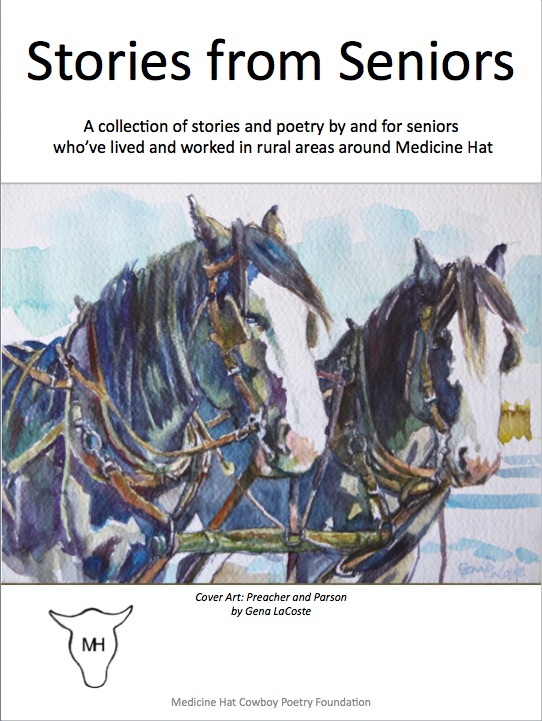
From “Stories from Seniors” by J. Zollner. It is one of the books MHCP published, a fund-raiser with Hale Hearing as the print sponsor.

Wishing you a Happy and Healthy 2026.
Be ready for the ride and thankful for the journey,
Jen