Keeping You In The Loop — MHCP Newsletter January 2026 Edition

Howdy !!!

Everyone has a story! The songwriting workshop got me thinking how storytelling is very much central to what I think Cowboy Poetry is about. On cattle drives, cowboys took their stories and put them into poems and songs. That fulfilled some of their immediate needs: used up time during the boring days, entertained each other around the campfire after chuck, and it kept them awake and the cattle calm when they were on night watch. An important part was connecting with the other wranglers on the drive. Just as it had social and emotional benefits then, with modern technology, it is even more necessary.

Stories, at first, are simply a means of telling someone about an experience or incident. It can then can be transformed into a poem, or the rhyming lines put to music. There is something in storytelling that is cathartic for the author as well as the listener. When author’s ideas are ones the listening folks can identify with, that’s when there’s that sense of human connection.

Between the lines of poems there are often other more subtle themes. In this newsletter, it helps us remember (or has us realize) the responsibilities that were given to young children. There is the reality of having to adjust activities to accommodate life’s circumstances. We’ve all experienced the strong bond to a horse or pet and having to let go of them. The need to work as a team is another imbedded concept. The list could go on.

Let stories be part of your new year, as we tell them and as we serve as active listeners. The connections made are bound to enrich Cowboy Poetry enthusiasts and other folks too.

Jen

MHCP AGM

Friday, February 13th, 2026
Western Music and Cowboy Poetry

From 10:00 to 12:00 in the Honor Currie Room
For Steerheads, Oxtails and Prairie Oysters, too

And with any luck, we might have a book launch!

We’ll again be joining with the Library’s Community Coffee

The AGM meeting starts at 12:30pm. Everyone welcome to that as well.

Free Songwriting Workshop

by John Wort Hannam
January 27 & 28, 2026
at Medalta Potteries
From 5:00-9:00 pm

John invites you to join him for his travelling songwriting project. It’s okay if you’ve never written songs, don’t play an instrument or don’t sing. The focus will be on the creation of lyrics based on stories in your life. Through discussion, examples and writing exercises, he’ll guide you to express yourself and tell your story through song craft. These workshops provide a respectful and safe space to share personal narratives and collaboratively shape original music. John aims to bring out that creative side you thought you didn’t have. Click Here to Register.

Granny Poet Program Goes Over Well

The entertainment was different from what is usually ‘on stage’ on the third Thursday in Victory Church’s Fellowship Hall. On December 18th, about 25 folks gathered much like the cowboys after their evening chuck of bacon, beans and biscuits. It was a little old granny (Jen) in a rocking chair that recited poems (some she wrote and some she didn’t) and did songs, some acapella like the cowboys did. The preambles gave the reason each piece was written, often including some reference to the times when Cowboy Poetry started. It was evident from the chuckles that many folks remembered bathing in a galvanized washtub and ordering from the Eaton’s catalog. One of the poems was about the value of community to Norman Fedrau who is blind; they learned how to ‘read’ paper money with Braille markings and by how it’s folded). “Twas the Night Before Christmas When Out on the Ranch” included harmonica which was the most common musical instrument on the cattle drives. The afternoon program ended with Alan Jackson’s “Let it Be Christmas” and coffee. The take-home was an M&M Christmas card/poem and treat.

Not every audience can relate to horses and cattle, or want to have everything be about cowboys. In order to keep Cowboy Poetry alive, the topics include ones the audience can relate to; they enjoy the surprise endings of some and the humor in other poems. It’s equally important to help folks imagine what times were like on the trail drives where this unique genre took root.

Little old granny (Jen Zollner) recited poems and did songs, some acapella like the cowboys did at the Victory Church’s Fellowship Hall. Dec 18, 2025.

Local Poet Noel Burles Nominated

MHCP was excited to learn that our friend and board member, Noel Burles has been nominated for The International Red Carpet Award Show in Europe. The competition has a limited number of nominations from all over the world and from a wide variety of genres. Participants will present their performance to a professional jury consisting of people with different focus in the music industry and a dedicated team of judges just for Cowboy Poetry. Best of luck Noel!

A Boy and his Appaloosa by Jim Burk

Jim Burk was raised on a small mixed farm near Sundre, Alberta. His dad, Delos Burk, always said they were horse-poor with lots of horses providing little income. When Jim’s dad came in contact with Jim Wyatt, a rancher near High River who had begun breeding Appaloosas, he arranged to have a strawberry roan mare bred to one of Wyatt’s stallions. The result was a G1, a Generation One Appaloosa.

Learning about Appaloosas and their near extinction was food for Jim’s imagination. Still recovering from rheumatic fever, and a little weak for normal farm chores, he was given the task of exercising horses being made ready for sale. His father presented Gypsy to Jim as a two-year old. At the age of twelve Jim was an experienced rider. He rode two and a half miles to school beginning with grade one and rode unsupervised when he felt like exploring. And this being bush country gave much to explore.

As a result of having riding as his main contribution to the farm, Jim had a lot of time to work with Gypsy. Also, good advice from his father, an excellent horseman and horse trainer whose mantra was: “If you’re training a horse and it bucks, that’s your fault.”

Gymkhanas were popular at the time with a variety of races involved. Gypsy was particularly good at barrel racing and pole bending.

When Jim Wyatt had the first National Appaloosa Gymkhana event at his ranch, Jim’s Dad urged him to enter. So he did.

The horse was ready. Jim wasn’t and did what most novices do. He ran Gypsy through all the motions necessary for each event over and over again. As a result Gypsy had worked up a sweat and a load of confusion before the first race, which was barrel racing. She swapped ends in the middle of the first dash and still placed third.

At the end of the day Gypsy was the third high point Appaloosa Gymkhana Horse in Canada. She worked against horses from as far away as Ontario. However, while some of Gypsy’s opposition had prosperous owners, most of the other riders were not necessarily good horsemen. In any case, Gypsy earned Jim some bragging rights.

Jim was fourteen at the time and just finished grade eight. With no high school in the vicinity, that summer spelled the end of his time with a horse that had almost become part of him. Not to mention the fact that she was sold. In the end Jim’s dad had to ask for his gift back. If sold, the money gained would pay for an electric pump that would bring cold running water into his mother’s kitchen. Sad, but gladly given. Best part. Jim was away when Gypsy left the farm.

(This is an example of a story that could easily be written in poetry form, with a preamble to
introduce it.)

An Author Among Us

It’s been exciting to get to know someone in our midst (at Victory Church) and learn of his
accomplishments. His bio is the story of something unfortunate turning into blessings that
continue to the present day. His life story is also an example of not letting obstacles get in
your way, not letting others define what you can and can’t do. He has written a number of
books to date and currently has two goals: to finish his last book(s) and to go horseback
riding. On “Amazon.Jim Burk” you’ll find summaries of each of his books and excerpts that
have you wanting to keep reading. Orders can be made in Book or Kindle format.

Read more about Jim Burk in our upcoming “Homegrown Tributes” series

The Appaloosa Story

The breed is known for its spots over standard horse colors. In addition are the straited
hooves, strips of black and light gray. The hooves have a hard and a soft structure able to
stand up in both rocky and sandy terrain.

The Appaloosa is a breed propagated by Nez Perce aboriginals of Oregon, Washington and
Idaho. The breed was almost erased when the American cavalry destroyed most of the
Appaloosa stock held by the Nez Perce.

The horses used by Native Americans in the West largely came from the Spanish horses brought into Mexico with partial lineages going back to Arabia. In the mid-17th century, large Spanish herds were used around Santa Fe and Taos. The Spaniards attempted to keep the horses from the Native Americans, but escaped Indian slaves and stolen horses resulted in Apache and Navajo acquiring horses, rapidly putting their new equestrian skills to masterful use. The 1670 Pueblo Revolt resulted in thousands of horses being left behind by the fleeing Spaniards. As Spain continued to lose control over Northern Mexico, even more horses found their way into Native herds.

By 1700 the Shoshone tribes of the Great Basin had acquired horses from their southern cousins. Around 1730, the Nez Perce also had horses giving the Shoshone and Nez Perce a strategic military and hunting advantage over the plains tribes (the Crow and Blackfeet did not have the horse until c.1740 and the Sioux not until c.1770). The Spanish stock was ideal for the harsh environment of the Western U.S.and the Nez Perce recognized early on the benefits of selectively breeding the best horses for their particular environment and needs. Though the Appaloosa was not the only type of horse owned by the Nez Perce, it was easily the most identifiable.

In the mid 19th century, the U.S. Army often found their cavalry horses unable to compete with the horses of the Western tribes. The Army horses had been raised on grain, were used to abundant water, and often bred from racing stock, but the superior Native horses were grass fed and had far better endurance. Army officers often complained that their horses were not up to the task of chasing down the steeds of the Native Americans.

In many cases the Army, knowing the advantage the horses gave the Indians, destroyed their herds to remove the military power of the tribes and locked them into areas that could only be travelled by foot. So, after the Nez Perce War, the US Army tried to destroy the Appaloosa breed through the slaughter and breeding with draft horses. However, Chief White Bird had slipped across the Canadian border with women, children and some of their prize spotted horses. In Canada, he and his refugees kept the breed alive.

Revival & Modern Breed

Rediscovery: An article in Western Horseman in 1937 sparked interest, leading to the formation of the Appaloosa Horse Club (ApHC) in 1938 to preserve the breed.

Modern Type: The ApHC introduce Arabian, Quarter Horse and Thoroughbred bloodlines to develop the modern Appaloosa, creating versatile horses we know today.

Jim Wyatt, a rancher near High River brought the breed to Alberta. Delos Burk, my father, met Jim Wyatt at my uncle’s ranch in Simon’s Valley, west of Calgary, and decided to have one of his mares, a strawberry roan, breed to one of Wyatt’s stallions. The result was Gypsy, grey, with spots spreading from hip to mid-body. This was 1952.

In the fall of 1956, Jim Wyatt held the first ever Appaloosa Gymkhana Event at his ranch. Jim, Delos son, entered Gypsy. She was ready. Jim wasn’t. In spite of that, Gypsy earned the title of third-best Gymkhana horse in Canada. Had Jim kept his cool, he firmly believes she would have been first. It sounds good, but in spite of there being a competition from different parts of Canada by individuals who had taken to this new breed as an expensive hobby, there were few well-trained horses at the meet.

Sources: PowWows.com: appaloosa museum.com:

Western Music and Cowboy Poetry

-entertainment all afternoon. Mark your calendar!

Western Advice

  • cherish horses, women, water and grass
  • when in doubt, let your horse do the thinking
  • take as good a care of your horse as you do yourself
  • don’t approach a bull from the front or horse from behind
  • a clean saddle blanket is more important than clean sheets
  • don’t talk down to anyone even it if means gettin’ off your horse

Cowboy Lingo

  • fan tail – wild horse
  • plug – run-of-the-mill work horse
  • hack/nag – old and overworked horse
  • rat tail – appaloosa with a thin mane and tail
  • lunkhead – horse of inferior breed or appearance
  • bell mare – lead mare which the herd willingly follows
  • crow or buzzard bait – worn-out emaciated horse that will soon
  • become carrion and therefore attracted to crows or buzzards

Western Movies

There’s something about winter that makes one look for a good movie, best watched with a warm drink nearby. Westerns tend to tap into something deeper -family, resilience, tradition and doing what needs to be done even when it’s hard.

True Grit (2010)

Cold landscapes, quiet determination, and a story driven by grit and justice make this one feel tailor-made for winter watching. Hailee Steinfeld’s breakout role, paired with the Coen Brothers’ sharp storytelling, makes it an easy seasonal rewatch.

The Man Who Shot Liberty Valance (1962)

More reflective than action-packed, this classic explores legacy, truth, and the stories we choose to remember

The Searchers (1956)

A sweeping Western with emotional depth and stark scenery. It’s not light viewing, but it’s one of those films that lingers long after the credits roll — perfect for a quiet winter night.

Open Range (2003)

Slow-burning and atmospheric, this one leans into loyalty, moral code, and wide-open country. The pacing makes it ideal for settling in and actually watching, not just having something on in the background.

Legends of the Fall (1994)

Snowy Montana landscapes, family drama, and a powerful score give this film a wintertime feel. Emotional, cinematic, and timeless.

The Cowboys (1972)

John Wayne leading a group of boys across the West with its themes of mentorship, responsibility, and growing up.

The Homesman (2014)

Bleak, honest, and beautifully shot, this is a winter Western for viewers who appreciate quieter storytelling and strong performance, deeply human.

-from Cowgirl magazine

Molly and Mike, poem of the month

Harvey Beck spoke fondly of this team. He was but a boy about 8 years old when he was harrowing a freshly seeded field one spring with them. When he turned the corner too short, the pole with the harrows stuck upright in the ground and he landed in the soft dirt. He admired how Molly and Mike worked together as swing horses on the header at harvest time. At the corners, it took precise coordination to keep the header straight; at the same time as one went forward, the other had to back up. There wasn’t a team that could do it better. It reminded him of a couple that had danced together for years. (Harv, his brother and his dad played at dances.) He had spent many-an-hour driving this team. When he grew up and left home, Molly and Mike stayed ‘at home’, and that’s where they had a content retirement.

I can still see them, Molly and Mike,
Better partners there never will be,
If man and wife could just spend their life
Together in such harmony.

Even their steps were in perfect time,
Moved proudly as together they'd run,
Though no wedding vows, you'd see that somehow
The two of them worked as if one.

Molly and Mike were somewhat like twins,
Same size, black tail and black mane,
Dad of course, more than any other horse,
Said this team was so easy to train.

No secret that they were a favourite of Dad's,
They're the ones that took him to town
To get the mail, and he'd never fail,
When back home they'd get their rub down.

Can you imagine how the others would feel?
The six other nags that he had?
They lugged the plow, did the work but somehow
These two got to show off a tad.

Sunday's they pulled the democrat to church,
In winter, a closed-in sleigh,
My, did they prance taking us to the dance,
In the livery barn they got to stay.

We played for a dance in town one night,
Came a snowstorm, worst we had known,
Getting home, no use, but we let the reins loose,
That team got us safely back home.

I'll always remember Molly and Mike,
As close as two lovers could be,
Side by side as a team, almost clones it would seem,
They were one, a he and a she.

From “Stories from Seniors” by J. Zollner. It is one of the books MHCP published, a fund-raiser with Hale Hearing as the print sponsor.

Wishing you a Happy and Healthy 2026.
Be ready for the ride and thankful for the journey,


Jen

Keeping You In The Loop — MHCP Newsletter June 2025 Edition

Howdy Y’All !!!

My thoughts as I imagine me sitting on the grass, leaning against an old fence post:

Seems there are two sides to every story. Information isn’t always black and white, neither is it necessarily right nor wrong but tends to come in various shades of gray (with flashes of color to boot, like a duck’s vision). Research has a way of adding to the truth of a matter which was the case with Dale Rose’s story (and some who knew him may question the ‘truth’). Is there a right and wrong with the maternal and non-maternal actions of the duck hens? When gathering information about fence phones, I discovered ways some people used their party line; I thought I knew all about multi-person phones. In talking to a neighbor who just celebrated his 99th birthday, another of my assumptions needed to be adjusted when I found out our North Forres telephone line was never the barbed wire kind. We know how each person has his or her own perception, but the purpose of revisiting the past is to acknowledge and appreciate the struggles and accomplishments of those who came before us. It’s also a means by which to realize how much change has occurred.

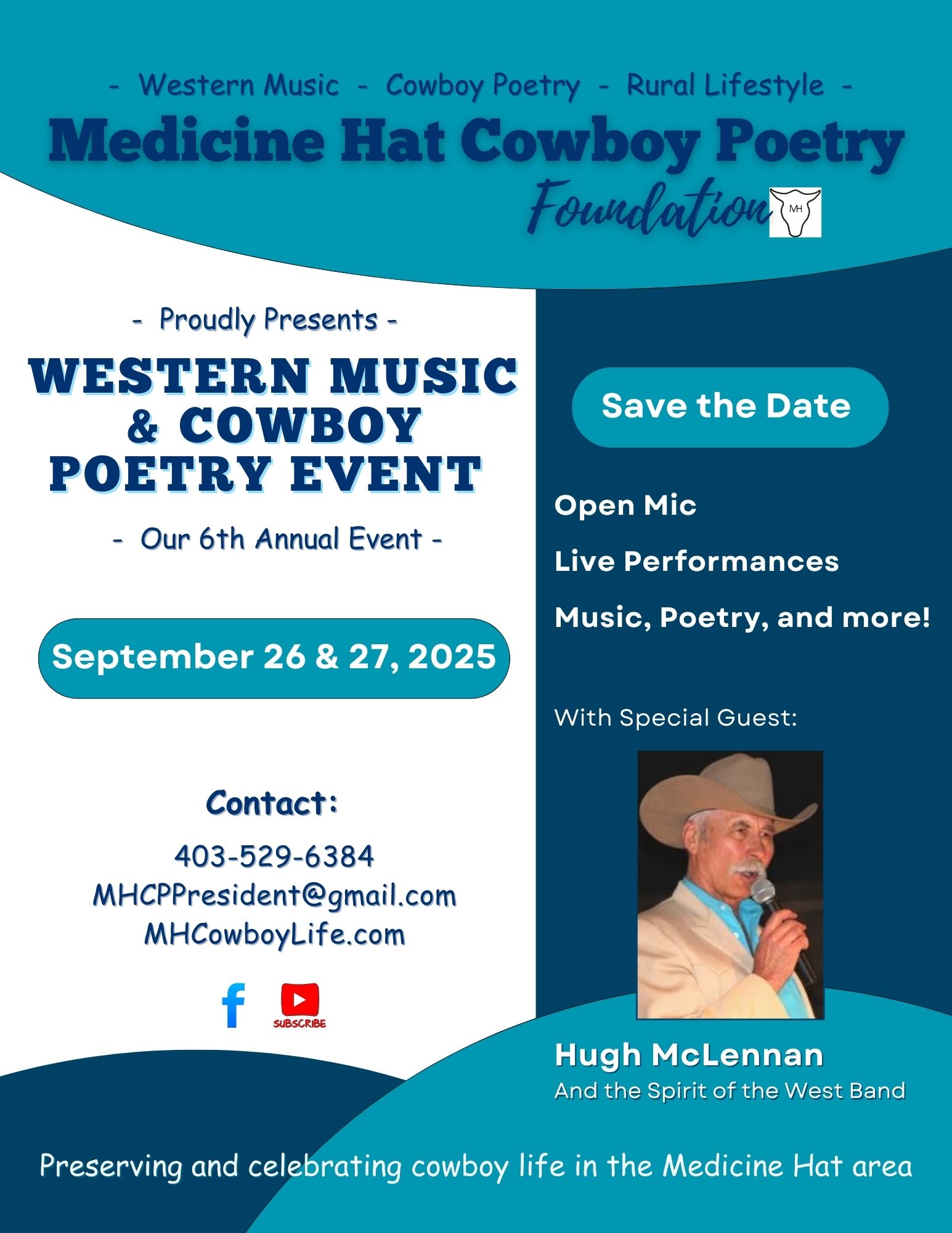
It’s that time of the year, time to trade-in that felt hat for your western straw. It’s also when initial plans are being made for the Western Music and Cowboy Poetry event. My personal thanks to the incredible MHCP Board members that will soon be putting up posters and getting ads out for our upcoming event on Friday and Saturday, September 26th and 27th, 2025.

Enjoy the summer!!

Western Music and Cowboy Poetry EventYou Don’t Want to Miss it!

The Western Spirit Band with Hugh McClennan
& Charlie Ewing and Lonnie to start the program

  • on Friday afternoon at Meadowlark Village (15 western entertainers)
  • on Friday evening at the Moose, Open Mic
  • on Saturday afternoon at MH College (15 western entertainers)
  • on Saturday, September 27th at 7:00 at Medicine Hat College

Cowboy Poetry on Rogers TV

To celebrate poetry month, Rogers TV Community Conversations offered to interview two members of the MHCP, Jen Zollner and Noel Burles to talk about Cowboy Poetry. On the video Noel did an excellent job of reciting two of his poems, one that paints pictures with rhyming words and one that has a surprising ‘hook’ at the end. They graciously advertised our upcoming event on September 26th and 27th, the Friday and Saturday. Thank you, Ian Parkinson and Rogers TV!

Preparations Underway for the Event

Performers are looking forward to being on stage for two afternoon shows, 15 of them, coming from Saskatchewan (Meadow Lake and Hazlet) and Alberta (Claresholm, Coalhurst, Lethbridge and Bindloss), as well as our own Medicine Hat. Hugh McClennan’s Western Spirit Band is the highlight of the Saturday evening show.

As well, Josie is the seamstress putting ruffles on our jean tablecloths. And Betsy, our mascot doll, has her wedding dress now. She borrowed it from Hannah, the neighbor’s 6-year old daughter. Bob, her fiance and the prospective groom, still needs to find something to wear.

Seventy-Fifth Wedding Anniversary

You read it right! Edgar and Florence Boschee celebrated 75 years of marriage. We interviewed Edgar telling the story of a heifer that fell down the well. The video “Stressful
Rescue”
is posted on our website under “Stories From Seniors” video series.

Barbed Wire Fences into Telephone Lines

Miles and miles of barbed wire fences were built on the prairies as a means of keeping cattle confined as well as keeping intruders out. Some farmers and ranchers rigged the existing fences to be able to talk to neighbors a distance away. In those areas, fence phones changed isolated homesteads into connected neighborhoods and communities.

Transforming the barbed wire fences into telephone lines was a simple procedure: hook a
store-bought telephone to the fence. Phones were readily available in Sears and Eaton’s catalogs since Alexander Graham Bell’s patent expired in 1890. A smooth wire (ideally copper) was strung from a telephone in the house to the top wire of the fence. The telephone signal would follow the length of the wire to a second telephone that was connected to the barbed wire down the line.

Sometimes as many as 20 telephones at various rural homes were connected onto a single barbed-wire system. The wire was either buried (in some kind of pipe) or strung overhead where roads and ditches formed gaps in the fencing. The pictured telephone is much like the one we had, a wooden box attached to the wall powered by its own batteries. When the hand-crank was turned, the magneto generated a ring-voltage to every house phone that was connected in that line. To begin talking, you needed to lift the receiver which would open the circuit.

Instead of phone numbers every household had their own ring, a kind of Morse Code; ours was two longs and a short. Other agreed upon rings were variations of long and short rings so folks would know if the call was for them e.g. four shorts, one long and three shorts, two longs, etc. A long and continuous ring signalled an emergency (or general message) for everyone to pick up and hear the important news. That was a party line.

Party Lines

The fact that everyone could listen in on every conversation was considered a good feature for some, a bad feature for some and an ‘interesting’ feature for others. A general ring, one long, indicated things such as a prairie fire, a storm warning or the need for urgent help. It was also an efficient means of announcing things like brandings or other social events. It was a quick way of spreading the word, and it was the one time it was all but expected to listen in on a call. It might even be okay to answer another’s ring if you knew about or were concerned that the party wasn’t answering. It was a means of looking out for each other.

Every party line (and the people on it) seemed to have their own rules of etiquette. Before you rang (turned the crank a certain number of short and/or long times), you lifted the receiver to see if anyone was on the line. Generally you weren’t supposed to eavesdrop on the conversation of your neighbor, but it was a common rural pastime. It was so easy (and tempting) to ‘rubber’ when you just had to pick up the receiver (even though a click could be heard when someone came on the line). For some it was like the newspaper and you didn’t know what was going on in the neighborhood unless you ‘rubbered’. One rancher quipped, “The neighbors always knew my wife was pregnant before she did.” It did serve to curb the loneliness where people lived miles apart. But it was irritating to get on the line to do business when people were ‘hangin” on it. During prohibition, those same guys appreciated being able to give neighbors time to hide their home brew operations by the time the government inspector came to their farm.

Some party lines even developed a rudimentary broadcast system. Those who were financially able to afford a radio were known to put the receiver up to the radio so others could listen to things like the comedy radio shows or the wresting match. Using the shared line they could send word that the train would arrive late, or broadcast the weather report or the weekly livestock prices. In one community five rings meant that someone with a radio had the evening news on. On some lines folks would read the newspaper over the telephone. Other lines would have musical nights where someone would play banjo, some sing along and others listen.

Maintenance

Building and maintaining the lines was a community effort, and though the systems were
workable, they were far from perfect. There were times when the voice quality wasn’t that
good. If the barbed wire was ever grounded, the phones wouldn’t work. Frequent outages
were brought on by cattle breaking through the fence or even an itchy bull rubbing on it. Rain or even wet grass leaning against the wire could stop the current. The insulators (that were used to keep the barbed wire from touching the post) weren’t always effective. Sometimes the lines would get weighted with ice or snow and snap. “During a lightning storm the phones would jingle constantly. The erratic current would render all the phones useless and you definitely did not want to use the phone at such times lest a bolt of lightning ended up between your ears. Everyone had a wild story about lightning coming out of the phone and shooting across the room.”1

Switch Boards

The first rural telephone systems had no central exchange or operators, no monthly bills and they were unregulated. Sometimes it was simply a line to a bachelor neighbor or lines to family members who were part of their neighborhood. Systems got more sophisticated by having a switchboard operating out of someone’s kitchen for a small monthly cash salary. Then telephone pole lines replaced barbwire fence ones. Services expanded to having a more central switchboard, being able to hook to other lines, and to having long distance service (with additional long distance charges, so much a minute).

This was how the manual switchboard worked: “There is a pair of copper wires running from every house to the central office. The switchboard operator sat in front of a board with one jack for every pair of wires that entered the office. Above each jack was a small light. When someone picked up the handset on his or her telephone, the hook switch would complete the circuit and let the current flow through wires between the house and the office. This would light the bulb above that person’s jack on the switchboard. The operator would connect his/her headset into that jack and ask who the person would like to talk to. The operator would then send a ring signal to the receiving party and wait for the party to pick up the phone. Once the receiving party picked up, the operator would connect the two people.”1

North Forres Rural Telephone Co.


My experience with party line phones started in 1964 with the North Forres Rural Telephone Company. The system was started in 1917, not as fence phones but with telephone poles and overhead wires. Over time it expanded to serve some 23 townships in 6 municipalities including the villages of Golden Prairie, Fox Valley and Richmound as well as the hamlets of Hatton, Tunstall, Horsham and Linacre. By about 1967, SaskTel began taking over all long distance service and it was sometime later that the black rotary dial telephone replaced the brown box-looking wall-mounted telephone. It was in 1977 that SaskTel completely took over the phone service. North Forres “was said to be the largest Rural Telephone Company on the North American continent.”2
(Coming soon on our website: the history of the North Forres Telephone Company.)

Conclusion

Two inventions were filed two years apart, barbed wire in 1874 and in 1876 the telephone.1
Who would have believed that together they would change the lives of many rural households! The need for them to be in touch was very real: physically, socially as well as psychologically.

Even before fence phones, neighbors had unique ways of alerting each other when the need was extremely urgent. “Sometimes a mother would be alone when something would happen to a child or there be a fire or a snakebite. Then the ‘distress pole’ was used. A neighbor seeing the white flag would hasten there.” The party line was a godsend for medical emergencies. “People no longer had to ring the bell on top of the barn to summon help.”3 Help could be requested and people passed the message down the line until it reached the
doctor.”1

Fence phones illustrate the ingenuity and cooperation prevalent among rural families in the
early 20th century. Groups of families otherwise isolated, lonely and in need of help worked
together to have low-cost telephone service. Left to telephone companies, farm people
wouldn’t have had telecommunication at all because building lines was expensive and not
worth the effort in sparsely populated areas. At one time farm households had more telephones than did urban homes (where one telephone in town would be used by everyone when needed). Barbed wire phones were early DIY projects, Do It Yourself. It became a social network with group chats and had the semblance of personalized ringtones, chat rooms and on line music. Talk was free, so people would ‘hang out’ on the phone for hours just as they do today on online social networks.

  1. Ranchers Hacked Barbed Wire Fences to Create Phone Lines by Laurie L Dove.
  2. Richmound’s Heritage (community history book)
  3. Echo, Horsham School Yearbook

Duck Story That Quacks Me Up

It’s been ducks galore in the Jamie Straub household. She was set up for success starting with 3 females/hens and 2 males/drakes. When she gathered their eggs this spring, she used an infra-red thermometer to be sure they’re fresh, above 12 degrees. In her self-turner incubator, with the dial turned to ‘Ducks’, she put 18 eggs and maintained the correct humidity by adding water. Twenty-eight days later every one of them hatched into the cutest little furballs.

In the duck-house there was less success. When she candled the 32 eggs, only 5 were good (the weather was cold out there), and only 3 of the 5 hatched under the hens (interesting how the three hens took turns sitting on the clutch of eggs).

For a time the ducklings were in their own space. (Jamie only found a different home for 4 of them.) It was interesting to watch when they were old enough to be put with the adults in the fenced outdoor run. One hen claimed them all, making it obvious with her mothering way that they were hers (the other two moms didn’t bother with them). When the 3 younger ones were introduced to her family of 14, she went after them saying in no uncertain terms, “You’re not mine!” The younger ones are still running with the flock, but it’s clear that they’re not her ‘chosen ones’.

Idioms with a Trail Drive Twist

  • dead duck – that’s a cattle rustler caught by a lynch mob.
  • lame duck – that was many-a remittance man, ‘ne’er-do-wells’ sent to the frontier with financial backing from their wealthy families in hopes the rugged life would finally make men of them.
  • sitting duck – that was a baby calf that happened to be born while on the trail, and was left behind for predators. Keeping them would slow the trail drive too much.
  • ugly duckling – the leppy; a small motherless calf in a range herd of cattle either orphaned or abandoned.

Western Wisdom from a duck perspective

“If you keep your feathers well-oiled, the water of criticism will run off us as from a duck’s back.” Ellen Swallow Richards

“Don’t quack like a duck, soar like an eagle.” Ken Blanchard

“Wild ducks and tomorrow both come without calling.” Russian Proverb

“A writer without a pen would be like a duck without water.” Donovan

“Being born in a duck yard doesn’t matter if you’re hatched from a swan’s egg.” Hans Christian Anderson

“Postponing happiness until all your ducks are in a row means never because life is
not clean, fair or predictable.” Laura Schlessinger

“Always behave like a duck -keep calm and unruffled on the surface but paddle like the
devil underneath.” Jacob Braude

Duck Vision Compared to Horse Vision

DucksHorses
Colours:Sees reds, greens, yellows, blues.
Sees colours vibrantly
Senses ultraviolet rays / radiation
Sees in 2 colours: blues and yellows
Red is seen as gray-ish
The fear yellow
Favourites:Favours mostly greens and into the bluesTurquoise and light blue
Dislike:WhiteBright, neon oranges and yellows
Night Vision:Can’t see in the darkNot as good as humans at night

Both ducks and horses can see almost all the way around without turning their head!

Guy Named Dale Rose (The Rest of the Story)

Dale Rose’s bio was in the March newsletter. It is the story most people know or have heard about him. Articles written in the Medicine Hat News about him (when he was with us) tell about another side of him. It seems he not only broke all the rules in the rodeo circles, he also surprises those of us that think we know what bullriders do and don’t do.

Dale grew up near Redcliff with his parents on a ranch that had been his grandfather’s. He
was a “plunky” youngster with a younger brother and a sister. It was in November at the age of 13 that he was stricken with osteomylitis that required him to be in a body cast for four months. He didn’t use it as an excuse to opt out of school though; he took correspondence
lessons and passed into Grade 8. It was during that time with the help of his brother, that they designed and constructed the replica of a Hudson’s Bay Trading Post. It was displayed in the window of the Hutchings and Sharp Store for years (description below). ( He was 14 when he made his first professional bullride at the Medicine Hat Stampede.)

“Dale Rose had the ability to write and recite poetry from memory … and the ability to tell a
story without resorting to vulgar words … He was very flamboyant and a very articulate speaker. He certainly had the gift of vocabulary and he had quite a high IQ … the cowboy who rarely, if ever cursed, lived hard, loved ranch life. He once wrote a novel that prospective publishers declared too wordy. They did publish his poems that examined the romantic western spirit.”3

Dale Rose loved working with wood and was described as being an “accomplished woodworker”4 Gwen Nelson commented on Facebook that “he was quite a craftsman at making puzzle boxes. Beautiful work!.” He was never afraid to take on big projects. He reported to Medicine Hat News that he was “taking the old Redcliff CPR Station and turning the abandoned structure into his house. He’d be ranching in the morning and home-building in the afternoon. He admitted he didn’t have any housebuilding experience and acknowledges. “my both thumbs will be a lot wider than they were by the end of the winter (of 1987)” “Once the house is complete Dale will set about making all the furniture.”4 It was where Dale lived and when he watched TV in the living room, he sat in a barber’s chair. It was an antique that was recovered with leather and re-chromed with all the hydraulics in working order. Dale Rose “won a fortune over an almost 30-year (bullriding) career and lost another fortune on various misadventures and his strong desire to beat the house at blackjack.”3 “He always thought that the only thing better than a little humor was a ‘lot’ of it.”5 “The guy was crazy and had his own way of doing things.”1

The Model Hudson’s Bay Post

Dale was a thirteen-year-old recuperating in a body cast when he took on this extra-curricular project. “With the help of his young brother Dan, 11, they designed and constructed a masterful replica of an old Hudson Bay Trading Post. Using only sketches from history books, Dale designed the extensive layout which is approximately 50 inches long and 30 inches wide. The brothers used only plywood on the wall of the fort itself with everything else made from burnt match sticks. The fort (and the people and animals inside) is a painstaking accurate reproduction of life in the pioneer days. Guard houses on each corner of the fort assures that no Indians will creep up. On the inside the minister walks to his church while Mrs. Jones hangs up her wash and Mrs Jones and Hank Smith gab a bit. A nifty trading centre, blacksmith shop, meat smoking shop, saddle shop, guard and supply house are all there as well as animals, children and people walking about. A varnish finish completes the job.”3

Sources:

  1. “Cigar Smoking Rider Will be Inducted in Canadian Hall of Fame” by Collin Gallant,
    Medicine Hat News, July 16, 2008
  2. “Learning the Ropes for the Featured Event” by Sheila Pratt, Medicine Hat News,
    July 19 ,1979
  3. “Plucky Dale Rose and Brother Build Replica Old Fort”, Medicine Hat News, June 10, 1955
    4.“The CPR Station Dream Home”, by Christine Diemert, Medicine Hat News, October
    19,1987
  4. Canadian Pro Rodeo Hall of Fame Facebook Page
  5. Interview with Don Thompson

Dale Rose, More than a Bull Rider by J Zollner, April, 2025

You can't judge a book by its cover, a bull rider's rap can mislead,
They're a breed of their own,
as Hoot, Dale was known,
And his colorful story is wacky indeed.

He fits the profile to the letter when at first you hear all about him,
Of danger no fear,
though the outcome is clear__
That one day his survival would look mighty grim. (he recovered from a broken neck)

It's Hoot against beast as he's spurring, got awards for the highest score,
He's a rodeo addict,
but with rawhide grit___
It's hard to believe that he had a soft core.

He wouldn't resort to offensive language in the stories he loved to tell,
He would never curse,
loved to write in verse,
Was articulate, wrote a novel not a word he'd misspell.

He broke all the rules for bull riders, calf roping considered as wrong___
As his necktie and white shirt,
while riding in the dirt,
He smoked a cigar as his bull bucked along.

Oh, the start that he gave young bull riders with his stock & the training he gave,
Ev'ry Thursday night,
ev'ry young guys delight,
Soon he had started a bull riding wave.

He was an accomplished woodworker, made puzzle boxes, all things small,
Was a house renovator,
and a furniture maker,
But betting in blackjack was one big downfall.

The misadventures he had were varied, won a fortune, and then it was lost,
A fun-loving guy
and we can't deny
There were always those times, when common sense lines, were crossed.

Don't we all have those times, when the danger signs, are tossed.

Whether you’re riding or hiking or driving this summer,

Happy Trails,


Jen

A note from the MHCP Webmaster:

Howdy, folks!

We’ve been burnin’ the midnight oil fixin’ up the MHCP website to make it better than a fresh cup of coffee at sunrise. But, like any good cattle drive, we’ve hit a few bumps along the trail.

If you spot somethin’ that ain’t quite right—maybe a picture’s gone missin’, a link’s as dead as a desert creek, a page loads wonky, or the whole dang site’s gone belly-up (heaven forbid!)—don’t be shy. Holler at us by sendin’ an email to penellazollner@gmail.com or leave us a comment.

Thank ya kindly for ridin’ with us and bearin’ with the dust. We sure do appreciate your patience!

Happy trails,
The MHCP Team