(Photo: Canada. Dept. of National Defence / Library and Archives Canada / PA-173657)
The American marines have an equine hero of the Korean War, “Sgt. Reckless”, and the British have “Warrior” who survived the horrors of WWI. Canadians are proud of “Princess Louise”, a legendary hero that the New Brunswick boys saved and cared for in the death-riddled days of WWII.
Canadian soldiers were involved in a battle called the Italian Campaign. The 8th Princess Louise’s Hussars were mostly farm boys from New Brunswick and they were on the front lines. They had once been a cavalry unit with a long and distinguished history dating back to 1775. By 1944, the 8th Hussars’ horses had long since been replaced by tanks. These military men were driving tanks, but they still had a deep-seated affection for horses.
They fought in the heat of the summer and the cold of winter for almost two years. The story begins on a sweltering hot night on September 15th, 1944. The Hussars were fighting tooth and nail to gain ground. The civilians hid wherever they could, but their farm animals were not as lucky, and before long the fields were littered with dead animals.
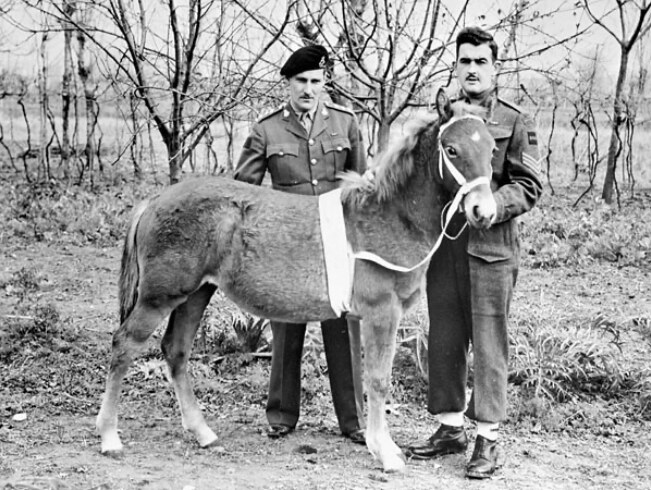
In a moment of lull they heard the cries of an animal in distress. They finally found it, a filly about two or three months old walking around its mother that had been killed by artillery shell several days earlier. The colt was so skinny that the bones were showing through her skin and she was in dire need of medical attention. According to Lt. Col Bob Ross (originally from Hampton), second in command. “This sorry sight, of course, tore the hardened hearts of ex-cavalry fitters virtually to shreds”. He was overwhelmed with volunteers to save the colt, so he finally had to agree. With artillery above their heads, the expedition returned with only one tank, and they had the baby.
Once back to safety and in daylight, the Canadians realized they had rescued an unusual-looking horse. She had a rather long nose (even for a horse), stubby little short legs and a rather round torso. She had deep cuts from artillery shrapnel. The medical officer protested that he was no horse doctor, but he agreed to take care of her. The soldiers found oatmeal and powdered milk for her. But how to sedate this horse when he was short of drugs? The Maritime solution was to get her super drunk on rum. There were lots of flies, so infection was a constant worry as the boys helped change bandages and care for her. There was really no debate over what her name should be: Princess Louise after the regimental title of the 8th Hussars.
As Princess Louise began to heal, the Canadians grew possessive of her, but several Italian civilians claimed that she was their horse. It seemed Princess Louise decided she would be going with the Canadians. She would try to bite and kick at the Italians if they got too close. However, she was fond of anyone who was wearing the Canadian khaki.
Then the Hussars were needed to help liberate Belgium and the Netherlands. But there were strict orders that no animals be taken out of Italy. With the help of Major Bob Ross, the boys managed to sneak her out, move her by loading up a 3-ton truck with machine guns, putting machine gun boxes up the sides, and leaving a ‘stall’ in the middle for the colt and the sergeant. After a ship and train ride, the 8th Hussars and Princess Louise arrived in Belgium in time for the victory parade there. Then they joined other Canadians to liberate the Netherlands from German occupation. Here Princess Louise worked as a warhorse, pulling a two-wheeled gig to bring supplies to soldiers. Five days later Nazi Germany surrendered and the war was over in Europe.
As the 8th Hussars thought about their eventual trip home, what would happen to Princess Louise? The rules were clear -the horse was strictly forbidden from coming back to Canada. Nobody seemed to understand the special bond they had with this animal. After much pleading they won their case with J.C. Patterson, the Canadian Pacific Railway representative in Europe. He already had to deal with a lot of paperwork to get the horse on the train before. He would “personally see that the horse was transported to Canada if he had to swim the whole distance towing the Princess on a raft.” However, due to terrible weather when the 8th Hussars went home, Princess Louise had to stay behind in Europe. J.C. Patterson was the one left to take care of the horse that had been causing him such annoyance.
That was the last anyone heard of Princess Louise for about a year. By March of 1946, the troops had long since returned home and the story of the colt became a legendary tale in New Brunswick. Everyone wondered what had become of her. Against orders it was arranged for her to be shipped to New York aboard a Dutch liner. Princess Louise was then met by one of the Hussars in New York, placed aboard a train and taken to St. John where on arrival she was greeted by a military honor guard, the city’s mayor and thunderous cheers.
She was reunited with her life savers, those who loved her and smuggled her and made her their mascot during the awful days of war. At neighboring Rothesay, children were let out of school to watch as she was paraded. She was taken to the courthouse steps at Hampton where she was given a bale of hay, a bag of oats and a shovel. There she was proclaimed a Canadian Citizen and a free woman in King’s County. She was entitled to “roam at will in the community and devour as she pleased, whether from a garden or Sharp’s Feed Store.” In a final fitting honor, she was made a full-fledged member of the Hampton Legion Branch with her hoof print marked on the membership form.
Princess Louise was a hit wherever she went. In parades she was dressed in Hussars’ full regalia. She trotted at the lead of the parade, showing off her service medals: 1939-1945 Star, Italy Star, France and Germany Star, Canadian Volunteer Service Medal and three Wound Stripes. Thad Stevens recalled, “She knew about as much about parades as any soldier. At attention, she never moved.” She even learned to count by stomping her hoof, although Stevens admitted, “I’d give her a nudge when it was time to stop.” Sgt Gordon and Mary Bickerton took care of Princess Louise. One time while trying to apply for a military medal for Princess Louise, Mary said they chased her around a field in Sussex trying to get her to step on an ink pad because the form needed her signature.
She ate just about anything. Always she ate like a horse, favoring equine staples as well as enjoying tobacco, whiskey and beer. The only thing she didn’t eat was cheese. She was a comic. On her 25th birthday, a party was thrown in Sussex, the home of the Hussars. The chef at a local military base baked her a cake out of oatmeal and cigarettes and layered it with icing and raw carrots. When it was presented to her, she eyeballed it for a second, then drove her nose into the middle of it, nearly up to her eyes. She split the cake in two. Occasionally she misbehaved. She’d search pockets for sugar cubes when she was supposed to be standing at attention. Once she ate a bouquet of flowers intended for the guest of honor at a ceremonial parade. Another time she left a deposit at the legislature.
During the war, Princess Louise gave a glimmer of hope, beauty and love, boosted their morale during the darkest days. She lived the rest of her life participating in ceremonies, church events and parades.” She passed away in 1973, at the age of 29. She had 3 foals, sons Prince and Hussar, and daughter Princess Louise II who became the new mascot for the regiment after her mother’s death. Princess Louise II died at age 27 in 1981 and is buried with her mother in Veterans’ Park outside the community center in Hampton.
(Ana Dearborn-Watts wrote a children’s book about Princess Louise)
Sources:
www.veterans.gc.ca “Princess Louise.Memorial.Veteran Affairs”
www.site.rootsweb.com “A Horse, Hope and Humanity”
www.horse-canada.com “Princess Louise:Canada’s Equine War Horse”
Note: The Hussars took the Princess Louise part of their name from the 4th daughter of Queen Victoria and Prince Albert. Her full name was Princess Louise Caroline Alberta. She was wife of Canada’s then Governor General John Campbell. While Alberta was still NorthWest Territories, he named the future province in his wife’s honor. Lake Louise is also named after her along with regiments of the Canadian military.